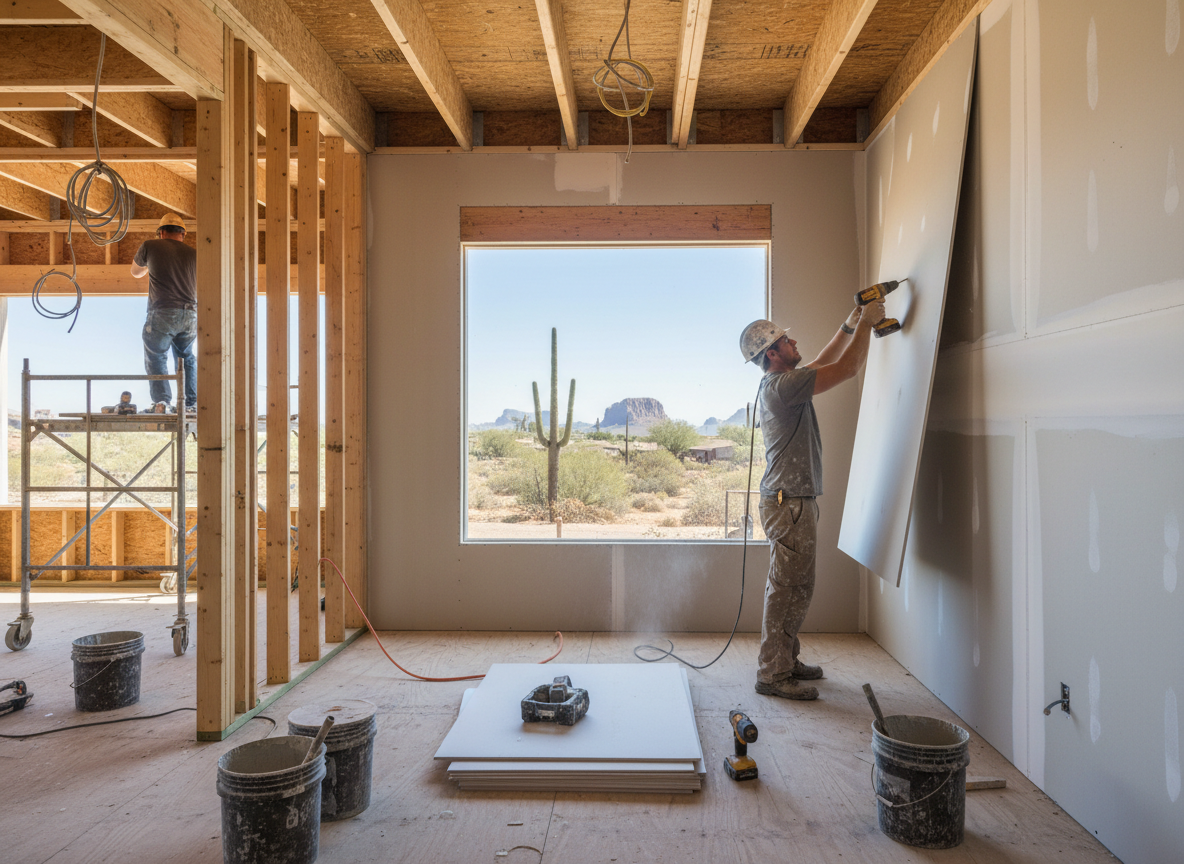
Gilbert homes in neighborhoods like Agritopia and Power Ranch often feature newer construction with larger open floor plans that require careful joint taping to prevent visible seams once summer heat pushes interior temperatures past 110 degrees. Drywall panels expand and contract daily in this climate, so crews working from 1911 E Baseline Rd focus on control joints and proper mud layers to avoid callbacks when monsoons raise humidity for a few weeks each year. Older stock near Downtown Gilbert and Layne Heights can have plaster transitions that demand matching textures rather than standard orange-peel finishes common in newer builds.
Maricopa County permitting rules for residential work require fire-rated assemblies in certain garage-to-living-space separations, and crews must account for the sandy soil conditions around San Tan Ranch that can shift foundations slightly and stress wall corners. Hot desert summers mean materials must be stored and applied before midday heat warps sheets, while mild winters allow year-round scheduling but still require attention to HVAC return paths that pull fine dust through any unsealed gaps. Homeowners in Queen Creek and Chandler often request smooth finishes for modern lighting, yet the same homes need extra corner bead reinforcement where door swings hit walls repeatedly.
Water intrusion from roof leaks or AC condensate lines is common in these areas and forces full removal of affected drywall rather than surface patching to prevent mold in the dry but occasionally humid air. Crews check for proper insulation depth behind new panels because the extreme temperature differential between day and night accelerates condensation issues if vapor barriers are incomplete. Service calls frequently involve matching existing textures in homes built during different decades, requiring on-site sample boards before final coats.
Technician insight
In Gilbert, the thing that catches most people out with Residential Drywall Contractor is how quickly seams open up again in homes around Power Ranch and San Tan Ranch when the extreme daily temperature swings hit walls that were taped without enough control joints.
Corner Crack Repair After Monsoon Season
A homeowner in Layne Heights noticed recurring cracks at ceiling corners each summer. We found the original tape had failed due to repeated expansion from desert heat. We removed the loose material, added control joints, and retaped with flexible compound suited to the climate. The corners stayed tight through the next temperature cycle.
How it works
- 1
Site Assessment
Measure affected areas in the Gilbert home, note existing textures, and check for underlying moisture or structural movement common in Maricopa County builds.
- 2
Material Selection
Choose drywall type and thickness suited to the room's exposure to heat and any fire-code requirements near garages or utility spaces.
- 3
Installation or Repair
Hang, tape, and finish panels or patches while accounting for daily expansion in the hot desert climate.
- 4
Final Texture and Cleanup
Match surrounding finishes, sand, and remove all debris before leaving the property.
Pricing
Pricing varies by scope and access; most residential patch or install jobs are quoted after an in-person visit rather than over the phone.