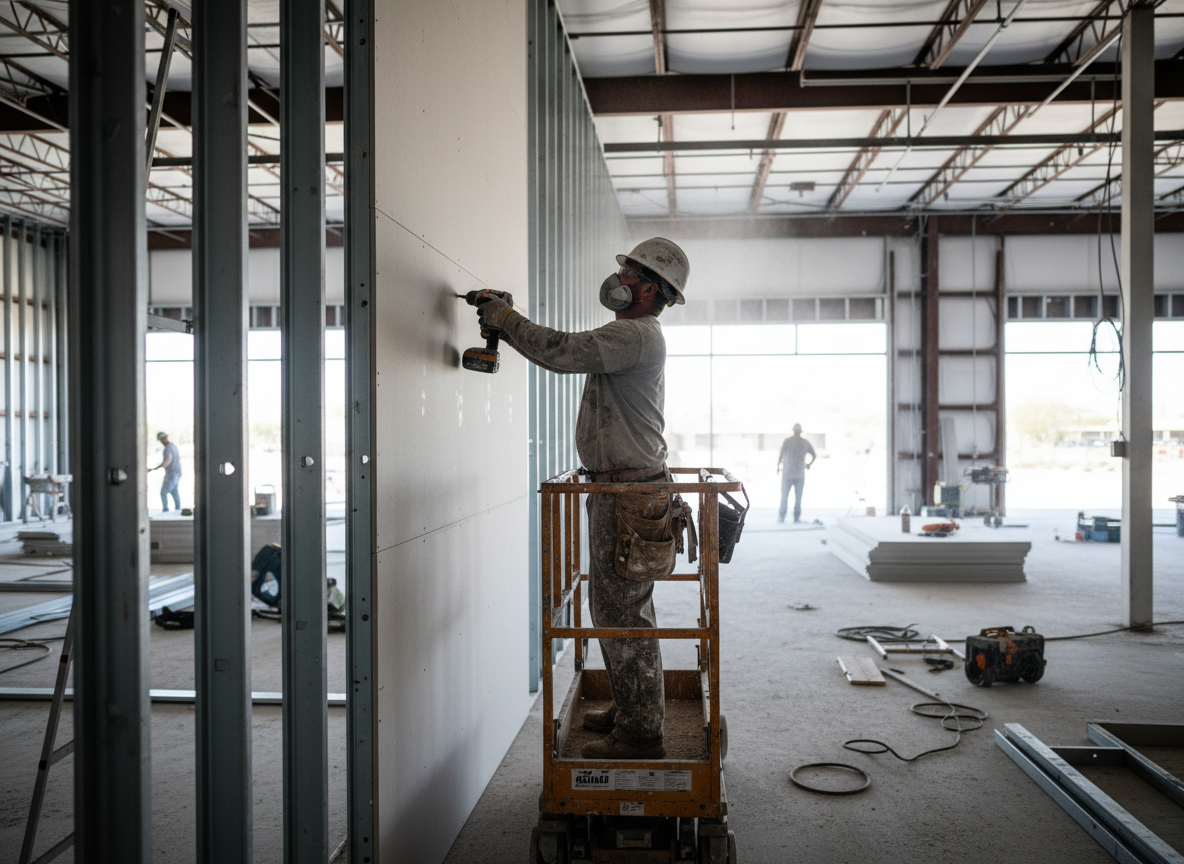
Industrial drywall projects in Gilbert often involve large open spans in warehouses and manufacturing buildings near Agritopia and San Tan Ranch. These jobs require moisture-resistant boards and high-temperature adhesives because summer heat regularly pushes interior surfaces past 110 degrees even with HVAC running. Proper joint taping and corner bead selection prevent cracking when the building cools rapidly at night.
Maricopa County building codes for industrial occupancies call for specific fire-rated assemblies around electrical rooms and mechanical spaces. Crews working in Downtown Gilbert or Layne Heights facilities must account for the flat terrain and minimal slope, which means any water intrusion from monsoon events travels horizontally across slabs and can wick into lower wall sections if base layers are not sealed correctly.
Nearby cities like Chandler and Mesa share the same soil conditions with high clay content that expands slightly during rare wet periods. This movement affects long runs of drywall on metal studs in industrial settings, so expansion joints must be placed at calculated intervals rather than standard residential spacing.
Power Ranch and Riparian Preserve area buildings frequently need impact-resistant panels on lower walls where forklifts operate. Selecting the right thickness and screw pattern avoids telegraphing fasteners through finished surfaces once seasonal temperature swings resume.
Technician insight
In Gilbert, the thing that catches most people out with Industrial Drywall Contractor is underestimating how quickly temperature swings between day and night move large metal stud walls. Facilities around Power Ranch and Heritage Court often show hairline cracks within the first season if expansion joints are skipped.
Warehouse Wall Repair Near Riparian Preserve
A manufacturing building showed recurring corner cracks along a 120-foot exterior wall. Inspection revealed missing expansion joints combined with daytime heat pushing interior temps high. We added proper control joints, replaced damaged sections with impact-resistant board on the lower eight feet, and finished to match the existing texture. The wall has remained stable through two full summer cycles.
How it works
- 1
Site Assessment
Measure all surfaces, note existing utilities, and check for prior water exposure in the facility.
- 2
Material Selection
Choose fire-rated and moisture-resistant boards suited to Gilbert's temperature extremes.
- 3
Installation
Hang, tape, and finish panels with expansion allowances for desert climate shifts.
- 4
Inspection and Touch-Up
Verify code compliance and address any surface imperfections before turnover.
Pricing
Upfront quotes based on square footage, board type, and access conditions.