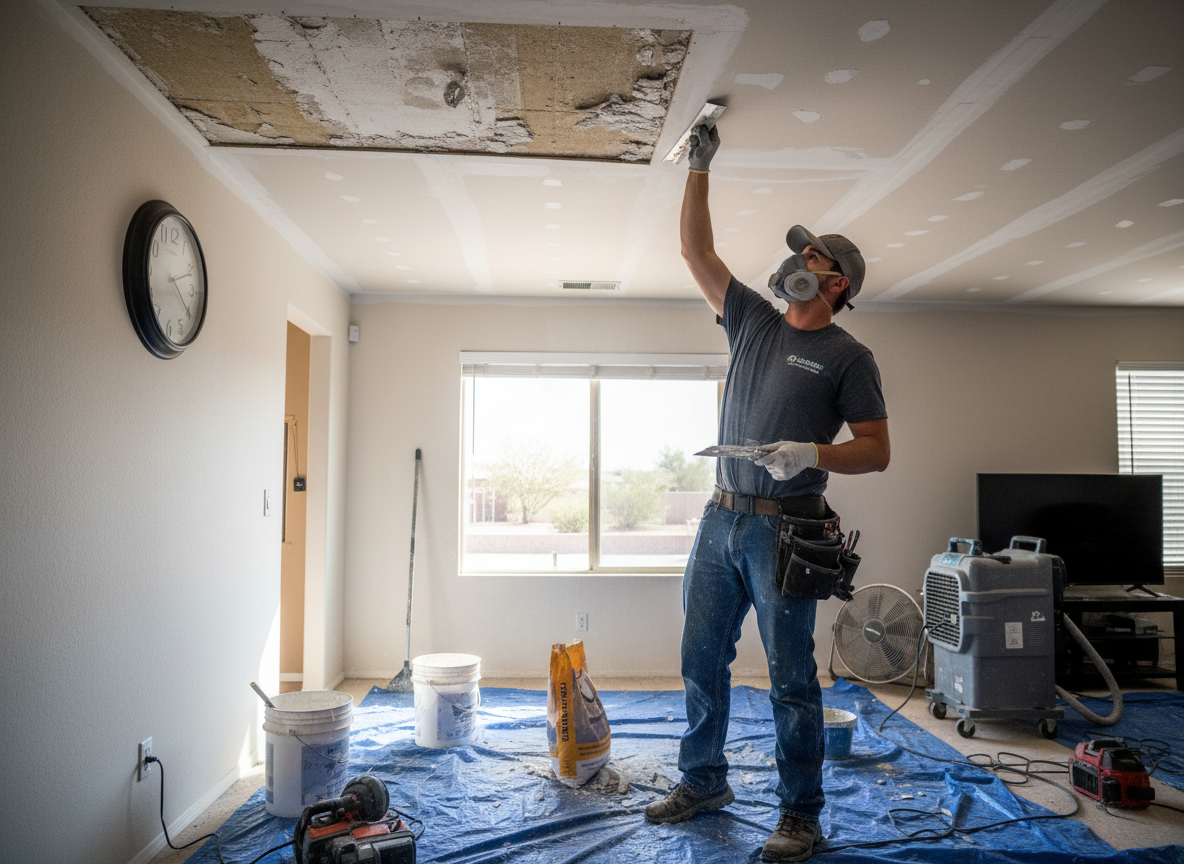
Gilbert’s hot desert summers and sudden monsoon rains create hidden moisture pockets behind drywall in homes across Agritopia and San Tan Ranch. Older stock in Layne Heights often has single-layer gypsum that wicks water from roof penetrations or slab-edge leaks, while newer builds in Power Ranch use paper-faced board that supports mold within 48 hours of saturation. We cut back to sound material, treat with EPA-registered antimicrobials, and install moisture-resistant board where humidity from evaporative coolers keeps wall cavities damp year-round.
Maricopa County building codes require removal of all affected insulation and verification that moisture content is below 15 percent before new drywall is hung. In Queen Creek and Chandler border homes we frequently find water traveling along truss chords from blocked scuppers, damaging ceilings two rooms away from the entry point. Edge cases include stucco-clad walls where exterior weep holes are clogged, forcing interior repairs that must match existing texture and paint to satisfy HOA standards in Heritage Court and Gilbert Regional Park vicinities.
We carry only 1/2-inch and 5/8-inch Type X plus cement board for wet zones, never standard board in bathrooms or laundry rooms. After monsoon season we see repeated callbacks on jobs where homeowners attempted DIY drying with box fans alone; residual moisture later causes tape failure along seams. Our process includes thermal imaging scans and documented drying logs that satisfy insurance adjusters working in the Gilbert area.
Technician insight
In Gilbert, the thing that catches most people out with Drywall Water Damage Repair is monsoon runoff pooling against stucco in San Tan Ranch and Layne Heights homes; the water travels under the slab edge and soaks the bottom plate weeks after the rain stops, so cutting only the visible blister leaves rot that shows up the next summer.
Hidden Ceiling Damage After Monsoon
A Power Ranch homeowner called after noticing a ceiling stain two weeks after heavy rain. We traced water from a clogged scupper along truss chords into the master bedroom drywall. Saturated sections were removed, framing dried and treated, and new board installed with matching orange-peel texture. No further staining occurred during the following monsoon season.
How it works
- 1
On-Site Assessment
We arrive 24/7, map moisture with meters and thermal imaging, and identify the water source whether from roof, plumbing or AC condensate line common in Gilbert homes.
- 2
Containment and Removal
Plastic barriers protect unaffected rooms while saturated drywall, insulation and baseboards are cut out to 12 inches beyond the visible damage line.
- 3
Drying and Treatment
Industrial dehumidifiers and air movers run until readings drop below 15 percent; antimicrobial is applied to framing in monsoon-affected areas like San Tan Ranch.
- 4
Rebuild and Finish
New moisture-resistant drywall is installed, taped, textured to match existing surfaces, and primed for paint in neighborhoods from Downtown Gilbert to Power Ranch.
Pricing
Cost depends on square footage affected, number of rooms, and whether hidden damage extends into ceilings or multiple walls typical after Gilbert monsoons.